
Key points
- Seasonality, not just weather, decides your pricing, your cash flow and your return on investment.
- Zanzibar received 917,167 visitors in 2025, up 24.5%, but two in three came from Europe, so Europe's calendar sets your peaks.
- Travelers differ in how free they are to choose their dates. Low season is not empty of travelers, only of the ones most hotels market to.
- Zanzibar has four seasons, not two, and each one needs its own price.
- In our example, a 20-room hotel earns about USD 393,000 a year but loses about USD 13,000 a month in the long rains. Planning for that gap makes the difference.
Introduction
If you are thinking of investing in a hotel, a villa or holiday property in Zanzibar, you will hear a lot of advice. Most of it covers the same list:
- Location: beach, Stone Town, or the quieter coasts
- Land and ownership rules for foreign and local investors
- Access and infrastructure: roads, water, power, internet
- Licensing and tax
- Staffing and operating costs
- Your target market: who you want to host
- Seasonality: when guests come, and when they don't
All of these matter. But one of them shapes your revenue every single month: seasonality. It decides when your rooms fill, what price you can charge, and how much cash you have left after the quiet months. In the end, it decides your return on investment.
The opportunity is real. According to the Office of the Chief Government Statistician (OCGS), Zanzibar received 917,167 international visitors in 2025, up 24.5% on 2024 and more than double the 394,185 of 2021. Supply is growing too: registered hotels and guest houses rose from 683 in 2021 to 980 in 2025, with 170 new properties and 2,298 rooms added in 2025 alone. More rooms means more competition for the same guests, especially outside the peak.
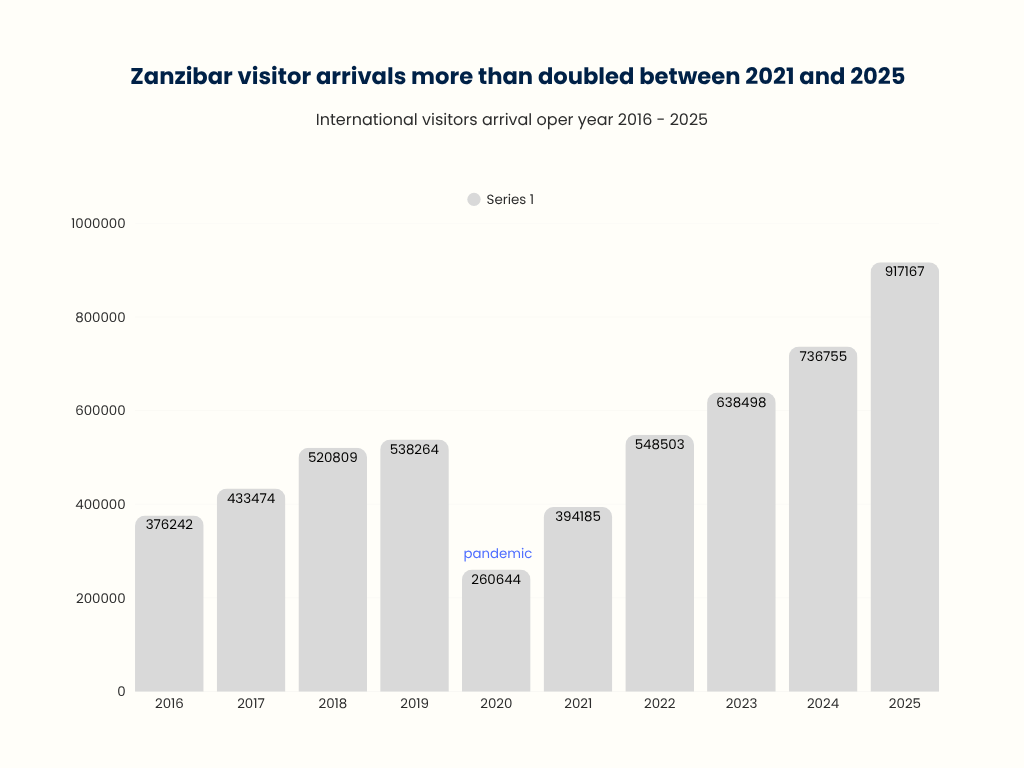
The 2020 drop is a reminder that tourism income can fall fast, and why cash reserves matter.
Now look at where those visitors come from. In 2025, 611,892 visitors, about two in every three (67%), came from Europe. Italy alone sent 104,265, followed by France (71,268), Germany (70,619), Poland (55,678) and the United Kingdom (53,309). That means Zanzibar's tourism calendar is largely set by one region's holidays, one region's economy and one region's flight routes.
But the mix is changing. Europe's share fell from 72% in 2024 to 67% in 2025. Arrivals from Africa grew 51% to 148,148, and from Asia 66% to 86,482. These travelers follow different calendars, which is an opportunity for properties that market beyond Europe.
Tourism is also the backbone of the economy. In 2025, accommodation and food services made up 17.5% of Zanzibar's GDP and contributed 2.2 percentage points to economic growth, more than any other industry. Zanzibar's airports handled 2.55 million passengers, up 13% on 2024.
This guide explains seasonality from the ground up. Not just the weather and the calendar, but the people who travel, why they travel, and when. Understand that, and you can price better, target the right guests, and earn a stronger return all year.
Start with the traveler
To truly understand seasonality, start with the people, not the weather. Every booking is a decision someone made: to rest, to explore, to celebrate, to work somewhere new, or to visit family. And every traveler has a different amount of freedom over when they can make that trip.
That freedom is the key. Some travelers can only come at fixed times. Others can come almost anytime. Once you see this, your calendar starts to make sense.
Traveler group | Who they are | When they come | Why it matters to you |
|---|---|---|---|
Locked to a calendar | Families, charter and package groups, Gulf travelers, Asian holiday travelers | European school holidays (July–August, Christmas, Easter), Eid, Golden Week | Their dates are fixed by school, work or religion. They create your peaks and will pay peak prices because they have no choice. The risk: they all want the same weeks. |
Experience chasers | Safari-and-beach guests, Kilimanjaro climbers, kitesurfers, divers, birders, photographers | When the migration, the wind or the water is right | They follow nature's calendar, not the school calendar. Many book a beach stay after a safari, so mainland demand flows to Zanzibar. Some actually prefer the green season. |
Flexible travelers | Honeymooners, retirees, winter-sun escapers, remote workers, budget travelers | Almost anytime, often avoiding crowds and peak prices | These are your low-season guests. They respond to good value, packages and longer-stay offers rather than deep discounts. |
Counter-seasonal | Domestic and regional guests, diaspora, business and conference travelers | Local public holidays, Eid, December, weekdays | They travel when international guests don't. Many hotels price and market only for foreigners and miss this market completely. |
Watch the fastest-growing markets, because they travel on different calendars. Between 2024 and 2025, arrivals from China rose 52% to 18,419, arrivals from Israel more than doubled to 12,350, and arrivals from Kenya and South Africa together grew 27% to 69,650. Each of these markets brings its own holidays, and with them, the chance to fill weeks that European guests leave empty.
The first group fills your best weeks. The other three decide whether the rest of your year is profitable.
Low season is not empty
Here is the most important message in this guide: low season is not empty of travelers. It is empty of the travelers most hotels market to.
In peak season, almost every decent property fills. The real difference between a good investment and a struggling one is what happens in the other months. The owners who win are the ones who know which guests can come in April, May or early December, and who build offers, prices and marketing for them.
Why there are seasons in the first place
Zanzibar is warm all year, so why does it have seasons at all? Because in East Africa, seasons are not about temperature. They are shaped by four forces.
1. The rain belt follows the sun. A band of rain clouds moves north and south across the equator through the year, following the sun. It passes over Zanzibar twice. That gives two rainy seasons: the long rains, Masika, roughly March to May, and the short rains, Vuli, roughly November to December.
The records confirm it. Over 2021–2025, OCGS data shows Unguja's April rainfall averaging about 377 mm, against about 32 mm in July. Rain also varies a lot from year to year: November 2023 recorded 776 mm, while other Novembers in that period ranged from 37 to 196 mm. January varies too: 253 mm in 2024 but only 28 mm in 2021, while February averaged about 24 mm. Plan for the pattern, not for exact dates.
2. The monsoon winds. The coast lives by two winds. Kaskazi, the northeast monsoon, blows roughly December to March: hot, humid, with calm seas. Kusi, the southeast monsoon, blows roughly June to September: cooler and breezy, which is why the east coast becomes a kitesurfing destination. These are the same winds that carried dhows between the Swahili coast, Arabia and India for centuries. Zanzibar became a trading hub because of when the wind blew.
OCGS wind records for Unguja show the same rhythm: average wind speeds of mostly 12–16 knots from June to September, falling to 8–12 knots in November and December.
3. The wildlife follows the rain. Many visitors come to Zanzibar after a safari on the mainland. The Great Migration in the Serengeti follows fresh grass, which follows the rain. When safari demand peaks, beach demand on Zanzibar follows.
4. Other countries' calendars. This is the force most owners underestimate. Because most visitors come from Europe, your peak is set by European school holidays, Christmas and Easter. Zanzibar's long dry season happens to fall during European summer, so good weather and peak demand arrive together.
The first three forces are nature. The fourth is people. Together, they create the four seasons below.
Zanzibar's four seasons
Most people talk about two seasons, high and low. In practice Zanzibar has four, and each one brings different guests, different prices and different risks. Month ranges are approximate and shift a little each year.
Season | Months | What's happening | Who comes | How to price |
|---|---|---|---|---|
Short Dry | Jan–Feb | Mostly hot and sunny, with calm seas under the Kaskazi wind. January can still bring heavy rain in some years; February is reliably dry. Safari calving season on the mainland. | Winter-sun escapers, couples, safari-and-beach guests, divers | Demand is steady and reliable. Hold your rates firm; there is little reason to discount. |
Long Rains | Mar–May | Heavy Masika rains, humid, rougher roads. Some hotels close. | Flexible travelers, budget travelers, remote workers, domestic and regional guests | Your hardest months. Don't race to the bottom on price. Use packages, long-stay rates and local marketing to keep rooms and staff working. |
Long Dry & Peak | Jun–Oct | Cooler and breezy under the Kusi wind. Migration river crossings on the mainland. European summer holidays. | Families, charter groups, safari-and-beach guests, kitesurfers, Gulf travelers | Your strongest months, especially July and August. Push rates, set minimum stays, and price June and October below the July–August core. |
Short Rains & Festive | Nov–Dec | Short Vuli showers early on, then the Christmas and New Year rush. | Flexible travelers early; families and holiday travelers late | Two seasons in one. Early November to mid-December is soft; the festive weeks are often the most valuable of the year. Price them separately. |
The lesson: "high season" is not one block, and "low season" is not one block either. Each part of the year needs its own plan.
Your seasons depend on what you sell
Two properties on the same beach can have very different years. Your season is shaped not only by Zanzibar's calendar, but by the experience you sell and the guests it attracts.
Property type | Typical guests | How seasonality affects it |
|---|---|---|
Luxury hotels and lodges | High-net-worth couples, honeymooners, safari-and-beach guests | Less sensitive to price and more flexible on dates, so the season is longer. Many also value the quieter green season. The challenge is protecting rates, not filling rooms. |
Mid-range and resort hotels | Families, charter and package groups | Strongly tied to European school holidays and tour operator contracts. Peaks are sharp; quiet months are deep. Dependence on a few operators is a real risk. |
Boutique and Stone Town hotels | Couples, culture seekers, short stays, business visitors | Less dependent on beach weather, so they can stay busier in the rains, especially with regional and conference guests. |
Budget and backpacker stays | Young and price-driven travelers | Flexible dates and lower prices smooth the year, but margins are thin. |
Villas and holiday rentals | Families, groups, long-stay guests, remote workers | Peak weeks are very valuable for groups. Monthly and long-stay rates can turn the rainy months into steady income. |
Activity-based stays (kitesurf, dive) | Kitesurfers, divers | Their season follows the wind and the water, not the school calendar, which can differ sharply from nearby hotels. |
Before you invest, be clear about what experience you are selling. It decides who your guests are, and your guests decide your season.
What can shift your season
Seasons are not fixed. Your busy and quiet months can move because of things that happen far from Zanzibar.
- Dependence on one region. When most visitors come from Europe, a European recession, a weak euro or a change in travel habits hits Zanzibar directly. Properties that also attract regional, Gulf or domestic guests are better protected.
- Flight routes. A new direct route can create demand in months that used to be quiet. A cancelled one can do the opposite.
- Charter contracts. When a tour operator adds or drops charter flights, whole blocks of rooms appear or disappear.
- Ramadan. It follows the lunar calendar and moves about 11 days earlier each year. It shapes the guest experience in Zanzibar, so plan around this year's dates, not last year's.
- Conferences and events. A major event on the island or the mainland can fill an otherwise quiet week.
History shows how fast a market can change. In 2021, Russia was Zanzibar's largest single source market, with 70,445 visitors, about 18% of all arrivals. In 2022, after the war in Ukraine began and travel routes were disrupted, that fell to 6,447, a drop of 91%. Over the same period Italy went the other way, from 6,674 visitors in 2021 to 104,265 in 2025, and is now the largest market. A property that depends on one country carries that country's risks.
The owners who watch these signals early can adjust prices and marketing before their competitors do.
What it means for pricing and return on investment
Your costs arrive every month. Most of your revenue arrives in a few. Salaries, rent, loan repayments, utilities and maintenance don't stop in April.
That is why seasonality is really a financial question. It affects your return in three ways:
- Pricing. One rate for the whole "high season" loses money at both ends. Peak weeks sell out too cheaply, and quieter weeks sit empty at a price guests won't pay. Matching rates to each season fixes both.
- Occupancy across the year. Your annual return depends less on how full you are in August, when most properties are full anyway, and more on how many nights you sell in the other months. That depends on targeting the right travelers at the right time.
- Cash flow. Knowing your quiet months in advance lets you build reserves, schedule maintenance and plan staffing, instead of being caught short.
An illustrative example
Take a 20-room boutique hotel with fixed costs of USD 30,000 a month (staff, utilities, maintenance, insurance and loan repayments) and variable costs of USD 30 per occupied room night. The figures below are illustrative, not data from a real hotel.
Season | Occupancy | Average rate (USD) | Revenue (USD) | Total costs (USD) | Net cash (USD) | Net cash per month (USD) |
|---|---|---|---|---|---|---|
Short Dry (Jan–Feb) | 70% | 180 | 148,680 | 84,780 | 63,900 | 31,950 |
Long Rains (Mar–May) | 30% | 120 | 66,240 | 106,560 | −40,320 | −13,440 |
Long Dry & Peak (Jun–Oct) | 80% | 220 | 538,560 | 223,440 | 315,120 | 63,024 |
Short Rains & Festive (Nov–Dec) | 55% | 200 | 134,200 | 80,130 | 54,070 | 27,035 |
Full year | 887,680 | 494,910 | 392,770 |
The year looks healthy, but the hotel loses about USD 13,000 every month from March to May. Without at least USD 40,000 set aside from the good months, the owner is borrowing, delaying salaries or cutting maintenance.
Now look at two small, seasonal decisions:
- Price the peak properly. Raising the July–August rate by just USD 20, with the same 80% occupancy, adds about USD 19,840 a year at almost no extra cost.
- Target the right low-season guests. A long-stay and regional-guest package that lifts rainy-season occupancy from 30% to 45% at a lower USD 100 rate reduces the Long Rains loss from USD 40,320 to USD 32,040, saving about USD 8,300, while keeping staff working and the property alive in guests' minds.
Neither decision needs a single new room. Both come from understanding the seasons and the travelers in them.
For investors, this changes the questions to ask before buying or building. Not just "how full will it be in peak season?" but "who will stay here in May, and at what price?"
Conclusion
Seasonality is not just weather and dates on a calendar. To understand it, you need to understand three things:
- The travelers: who comes, why they travel, and how free they are to choose their dates.
- The seasons: why they exist, and how each of Zanzibar's four seasons behaves.
- Your own property: the experience you sell decides your guests, and your guests decide your season.
High season will usually take care of itself. The real skill is knowing who to target in the rest of the year, and pricing each season for the guests who actually travel in it. That is where a good investment becomes a great one.
How Glenrich Consultants helps
Glenrich Consultants is an accounting and advisory firm in Dar es Salaam and Zanzibar, specialising in hospitality finance for hotel owners and property investors. We handle the compliance, and we find the risks underneath it.
Our team of CPAs, auditors, forensic accountants, tax consultants and investment advisors works with you as:
- Your outsourced finance team: accounting, reporting and payroll handled properly every month, so you always know where your business stands.
- Your CFO insight: seasonal pricing, cash flow planning and owner's reporting that turn your numbers into decisions.
- Your compliance partner: tax, filing and employee compliance in Zanzibar and Tanzania Mainland, kept up to date so nothing catches you out.
- Your assurance and forensic support: internal controls, audit readiness and investigations when something doesn't add up.
Whether you already run a property or are still planning your investment, we help you read your seasons, protect your cash and price with confidence.
If you want to see how seasonality affects your own property, send us your booking history or your investment plan, and we'll show you where the opportunities are.
Sources
- Office of the Chief Government Statistician, Zanzibar, Zanzibar Statistical Abstract 2025 (May 2026): Table G.1.1 (visitor arrivals by nationality), Tables G.2.1 and G.2.2 (hotels and guest houses), Table B.2.1 (monthly rainfall), Table B.2.4 (monthly wind speed), Table H.1.3 (airport passengers), Section E.1 (GDP by industry). Shares and averages calculated by Glenrich Consultants from these tables.