
Key points
- Location decides your guests, your season, your prices and your competition.
- The north is popular for swimming at all tides and sunsets, but crowded and competitive.
- The east coast has big tides; the south-east is windy, which kitesurfers love.
- Stone Town holds up best in the rains because its appeal is culture, not sunshine.
- The south, around Kizimkazi, is emerging: visits to Salaam Cave rose more than sixfold in 2025.
- The best location is not the most popular one, but the one where your property can stand out and fill rooms all year.
Introduction
Unguja, Zanzibar's main island, is small enough to cross in a couple of hours. Yet its coasts and towns attract very different travelers. A honeymoon couple looking for privacy, a kitesurfer chasing wind, a family wanting a pool and a calm sea, and a history lover exploring Stone Town will each choose a different part of the island.
For an investor, that makes location the most important decision after land itself. It decides:
- Who your guests are, and what they expect.
- When they come, because each coast has its own season.
- What you can charge, and how much competition you face.
- How easy it is to operate, from airport access to staff and supplies.
This guide walks through Zanzibar's main areas, what travelers look for in each, and what that means for anyone investing in a hotel, villa or holiday property.
What travelers look for
Travelers rarely choose an area by name. They choose by what they want from their stay, and then find the part of the island that delivers it.
What the traveler wants | Where they usually look |
|---|---|
Swimming at any time of day | The north (Nungwi, Kendwa), where the sea stays deep enough at low tide |
Sunset over the sea | The west-facing coasts: Kendwa, Nungwi and the Michamvi peninsula |
Quiet, privacy and nature | Kizimkazi, Jambiani, Matemwe and Pemba |
Culture, history and food | Stone Town |
Kitesurfing and water sports | The south-east (Paje and its neighbours) |
Diving and snorkelling | Mnemba Atoll off Matemwe, and Pemba |
Dolphins and marine wildlife | Kizimkazi and Menai Bay |
All-inclusive resorts and family holidays | The north-east (Kiwengwa, Pongwe) and the north |
Nightlife and a social scene | Nungwi, Kendwa and Paje |
A home, an apartment or a long stay | The west coast and Fumba, and Stone Town for city living |
Most guests combine more than one of these. A common pattern is a night or two in Stone Town for culture, then several nights on a beach. Properties that understand this can partner with each other rather than compete.
Zanzibar at a glance
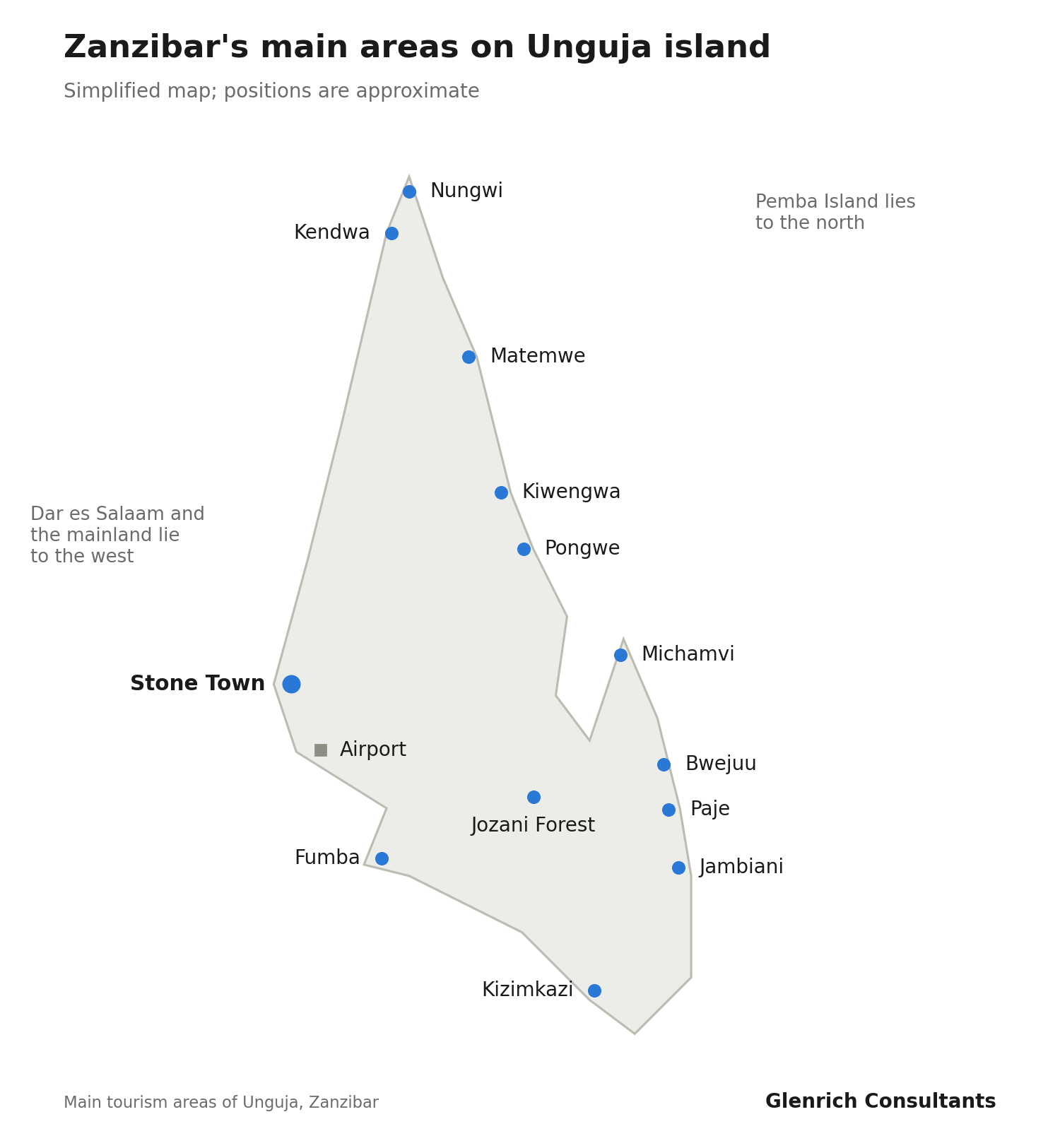
The beach areas run around the north and east coasts, while Stone Town, the airport and Fumba sit together on the west, close to the ferry from Dar es Salaam.
Area | Character | Typical guests | Investor view |
|---|---|---|---|
Stone Town | Historic, cultural, busy | Couples, culture seekers, short stays, business visitors | Year-round demand; heritage rules limit what you can build |
North: Nungwi and Kendwa | Lively, sunsets, swimmable at all tides | Couples, groups, young travelers, resort guests | Strong demand but crowded and competitive |
North-east: Matemwe, Kiwengwa, Pongwe | Long beaches, big resorts, strong tides | Families, package and charter guests, divers | Large resorts dominate; tied to tour operators |
South-east: Paje, Bwejuu, Jambiani | Relaxed, windy, social; Jambiani quieter | Kitesurfers, young and budget travelers, long stays | Busy in wind season; many small properties |
Michamvi peninsula | Secluded, sunsets on its western side | Couples, honeymooners, luxury guests | Boutique and luxury potential; limited land |
South: Kizimkazi and Menai Bay | Quiet fishing villages, dolphins, history | Nature lovers, couples, day visitors | Emerging area; growing interest, lower density |
West coast and Fumba | Close to town and airport, newer developments | Residents, long stays, property buyers | Residential and apartment projects, including for foreign buyers |
Pemba | Remote, green, uncrowded | Divers, eco and luxury travelers | Small market; high potential for niche, high-end stays |
Area profiles
Stone Town
Stone Town is a UNESCO World Heritage Site and the cultural heart of Zanzibar: narrow streets, carved doors, markets, rooftop restaurants and centuries of Swahili, Arab, Indian and European history. It is close to the airport and the ferry port.
Guests usually stay one to three nights, often at the start or end of a beach holiday. Because the appeal is culture rather than the beach, demand is steadier through the rainy months than on the coast, and business and conference visitors add weekday demand. The trade-off is that heritage rules strictly control renovation and building, so projects take longer and cost more.
The north: Nungwi and Kendwa
The north is Zanzibar's most popular beach area for one big reason: the sea stays deep enough to swim at low tide, which is not true of the east coast. Add west-facing sunsets, a lively atmosphere and Kendwa's beach parties, and it is easy to see why so many travelers head north.
For investors, that popularity cuts both ways. Demand is strong, but so is competition, and land is scarce and expensive. A new property here needs a clear reason to be chosen over dozens of neighbours.
The north-east: Matemwe, Kiwengwa and Pongwe
This coast has long white beaches and many of Zanzibar's large resorts, including all-inclusive properties popular with European charter and package guests. Matemwe faces Mnemba Atoll, one of the island's best areas for diving and snorkelling, and is quieter than its neighbours.
The tide here goes out a long way, so swimming depends on the time of day. Larger resorts depend heavily on tour operator contracts, which makes their seasons sharp and their fortunes closely tied to a few European markets.
The south-east: Paje, Bwejuu and Jambiani
Paje is Zanzibar's kitesurfing centre, with a young, social and international crowd. Bwejuu offers long, calmer beaches, and Jambiani is a quieter village stretch with a strong local character, where seaweed farming is part of daily life.
This coast has a big tidal range and is windy for much of the year, which is exactly what kitesurfers want. Many properties here are small guest houses and boutique hotels, often run by owner-operators.
The Michamvi peninsula
The Michamvi peninsula is a narrow strip of land with the open ocean on one side and Chwaka Bay on the other. Its western side is one of the few places on the east coast with sunsets over the water. It is secluded and attracts couples, honeymooners and luxury guests. Land is limited, which supports higher-end, lower-density properties.
The south: Kizimkazi and Menai Bay
Kizimkazi is a quiet fishing area in the far south, best known for dolphin trips into the waters of Menai Bay and for the Kizimkazi Mosque, one of the oldest mosques in East Africa. It feels a world away from the busy north.
Guests who choose Kizimkazi want calm, nature and authenticity rather than nightlife. The area is emerging: interest is growing, while density is still low. For investors, that means room to shape the market, but also the need to build demand rather than simply capture it.
The west coast and Fumba
The coast south of Stone Town, towards Fumba, is close to the airport and the city. This area has seen new residential and apartment developments, including projects that foreigners can buy into. It suits long-stay guests, residents and buyers looking for a home or a rental investment more than classic beach holidaymakers.
Pemba
Pemba, Zanzibar's second island to the north, is greener, hillier and far less visited. It is known for diving, its clove plantations and a sense of being off the beaten track. The market is small and harder to reach, but it suits niche, high-end and eco-focused properties that sell remoteness itself.
What the visitor numbers say
Official figures on visits to attraction sites show where travelers actually go, and how quickly that can change.
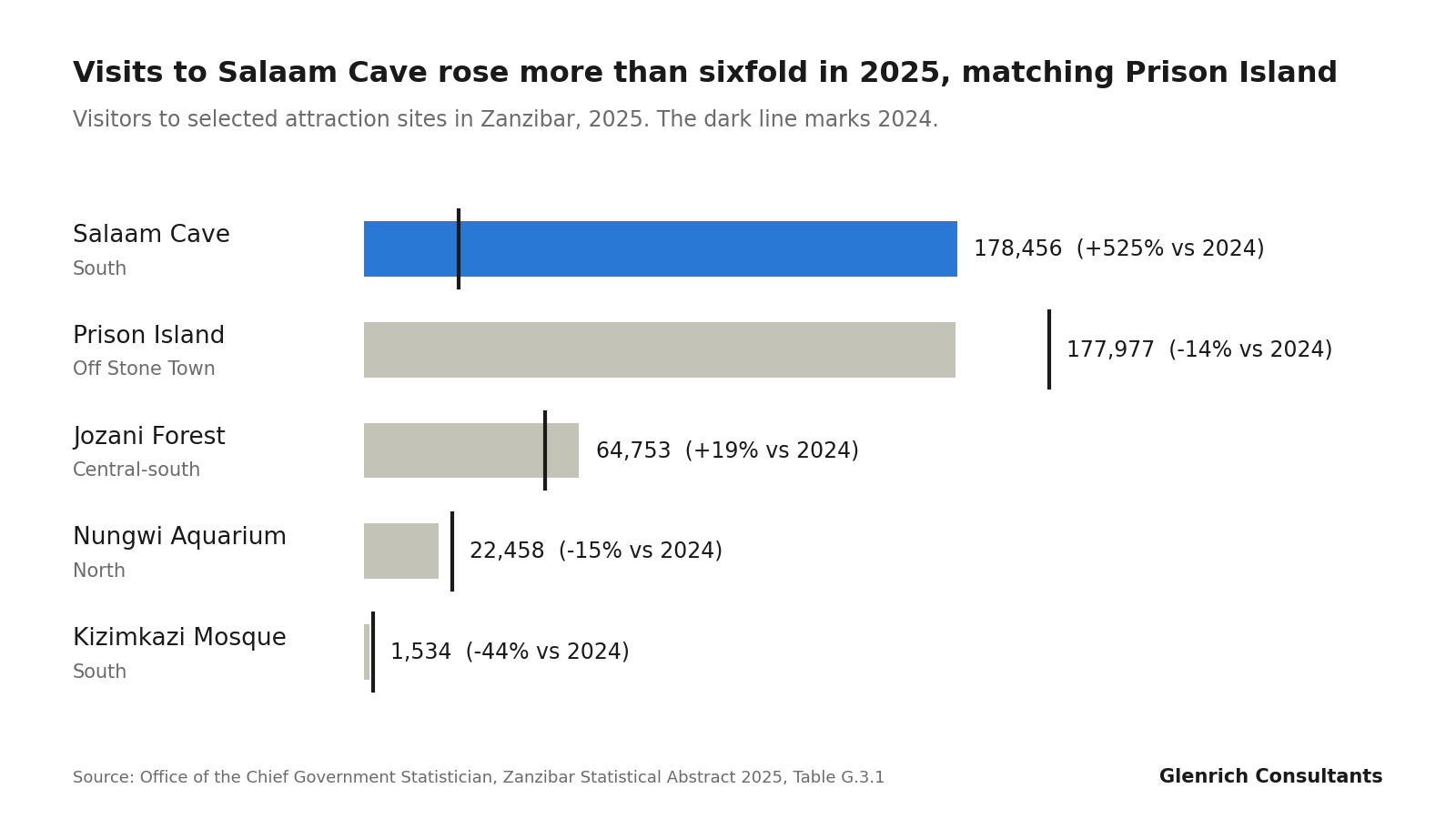
The south stands out. Salaam Cave went from a minor stop to one of the island's most visited sites in a single year, now drawing as many visitors as Prison Island off Stone Town. That is the kind of shift that signals an emerging area. Interest in the south is growing, while the number of properties there is still low.
Not every site grows: visits to Prison Island, the Nungwi aquarium and the Kizimkazi Mosque fell in 2025. Visitor patterns move, and an investor who watches them early can position ahead of the market.
How location changes your season
Zanzibar's four seasons apply to the whole island, but each coast feels them differently. Two hotels a short drive apart can have very different years.
- Tides. On the east coast, the sea can retreat hundreds of metres at low tide, revealing sandbanks and seaweed farms. Some guests love it; others want to swim whenever they like. The north's deeper water is one reason it fills first.
- Wind. The south-east is windy for much of the year, especially in the Kusi months from roughly June to September. That brings kitesurfers in, but can put off guests looking for a still, quiet beach. The north and west are more sheltered.
- Rain. In the long rains, from March to May, beach areas feel the drop most. Stone Town holds up better because its appeal does not depend on sunshine.
- Guests. Each area's guests bring their own calendar. Charter-led resorts on the north-east follow European school holidays closely. Kitesurf lodges follow the wind. Stone Town follows business, events and short city breaks.
For more on how the seasons work and how to price for them, see our guide, The Hotelier's Guide to Seasonality in Zanzibar.
Choosing a location as an investor
The best location is not the most popular one. It is the one where your property can stand out, fill its rooms across the year, and earn back its cost. Before choosing, you should be able to answer these questions:
- Who is my guest? Couple, family, kitesurfer, diver, long-stay remote worker? Pick the location that guest already looks for.
- When will they come? Map your guests against the area's season. A kitesurf lodge and a family resort can have opposite peaks.
- How crowded is the market? In a busy area you capture existing demand but fight for it. In an emerging area you face less competition but must build demand yourself.
- What can I build here? Heritage rules, coastal setbacks and planning limits decide your room count, and with it your maximum revenue.
- How easy is it to operate? Distance from the airport, road quality, water, power, internet, staff and supplies all affect your costs and your guests' experience.
- What is the land position? Title, lease terms and approvals matter more than the view. See our guide, Land and Property Ownership in Zanzibar.
- Does the area fit my exit? Think about who might buy the property in ten years, and whether the location will still appeal to them.
An investor who can answer all seven has done more homework than most of the market.
How Glenrich Consultants helps
Glenrich Consultants is an accounting and advisory firm main office in Dar es salaam, specializing in hospitality finance for hotel owners and property investors. We handle the compliance, and we find the risks underneath it.
When you are choosing where to invest, our team of CPAs, auditors, forensic accountants, tax consultants and investment advisors can help you compare locations in numbers, not just impressions: expected guests, seasonal occupancy and rates, building and operating costs, and payback. Once you are open, we act as your outsourced finance team, CFO insight and compliance partner.
If you are weighing up locations in Zanzibar, send us the areas you are considering and the kind of property you have in mind, and we'll show you how they compare.
Sources
- Office of the Chief Government Statistician, Zanzibar, Zanzibar Statistical Abstract 2025 (May 2026): Table G.3.1, Number of Tourists Visited Attraction Sites, 2021–2025. Changes calculated by Glenrich Consultants.