
Key points
- Zanzibar has two tax systems: income taxes go to TRA, while VAT, hotel levy and stamp duty go to ZRA.
- A hotel needs a series of approvals from different bodies, in the right order, before it can open.
- VAT and hotel levy must be built into your room prices, or they come out of your margin.
- A villa rented to tourists is usually treated like a small hotel for licensing and tax.
- Tax payments fall due every month, including in the long rains. Plan them into your seasonal cash flow.
Introduction
Most investors arrive in Zanzibar expecting one set of rules. They find two. Some taxes are Union matters, collected across all of Tanzania by the Tanzania Revenue Authority (TRA). Others are Zanzibar's own, collected by the Zanzibar Revenue Authority (ZRA). On top of that, a hotel needs licences and permits from several different bodies before it can open, and more to keep operating.
None of this is unusual for a tourism economy. But it catches out investors who assume Zanzibar works like the Mainland, or like their home country. The result is often penalties, back taxes, delayed openings, or a business that cannot be sold because its records do not stand up to scrutiny.
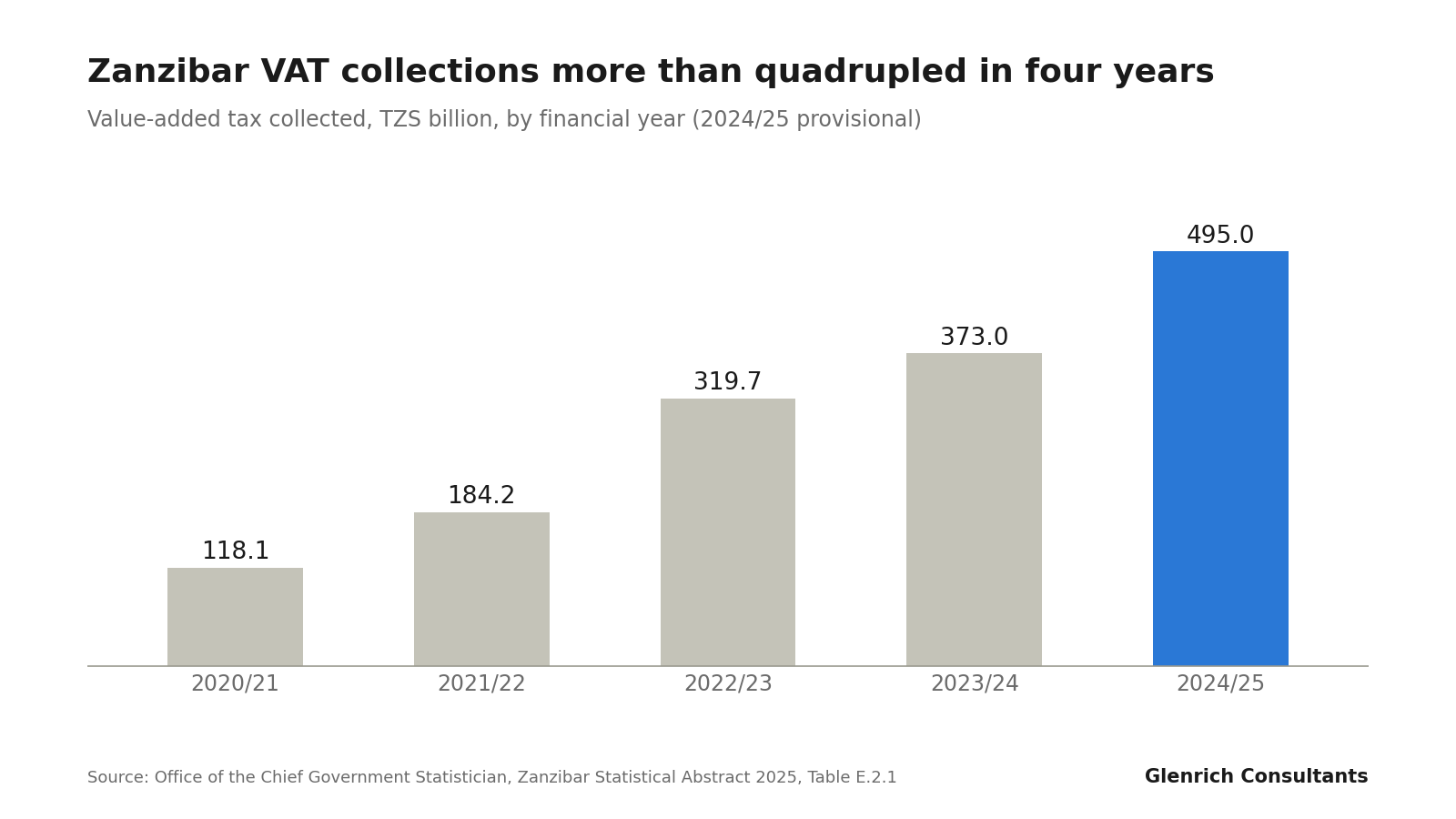
The tax net is also tightening. According to the Office of the Chief Government Statistician, Zanzibar's VAT collections grew from TZS 118.1 billion in 2020/21 to TZS 495.0 billion in 2024/25, more than four times in four years. Tourism growth explains part of that, but so does stronger collection. For hotels and property owners, informal arrangements that went unnoticed a few years ago are far less likely to go unnoticed today.
This guide explains how licensing and tax work for hotels and real estate in Zanzibar: who regulates what, which taxes apply, and where investors most often go wrong.
Two tax systems, two authorities
The first thing to understand is who collects what. As a general rule, taxes on income are Union matters handled by TRA, while taxes on goods, services, tourism and transactions in Zanzibar are handled by ZRA.
Tanzania Revenue Authority (TRA) | Zanzibar Revenue Authority (ZRA) |
|---|---|
Corporate income tax on company profits | |
Individual income tax, including PAYE on salaries | |
Withholding taxes, for example on rent, interest, dividends and payments to non-residents | |
Tax on gains when an asset or business is sold |
A hotel in Zanzibar will usually deal with both authorities every month. Each has its own registration, its own returns, its own deadlines and its own penalties. Treating them as one system is one of the most common sources of mistakes.
On top of the two revenue authorities, payroll brings contributions to the Zanzibar Social Security Fund (ZSSF), and local councils charge their own service levies and fees.
The licenses a hotel needs
A hotel does not get one license. It collects a series of approvals, each from a different body, at different stages of the project. Missing one can stop an opening or close a property that is already running.
Stage | Approval | Issued by |
|---|---|---|
Setting up | Company registration | Business and Property Registration Agency (BPRA) |
Tax registration and taxpayer numbers | TRA and ZRA | |
Investment approval and certificate of incentives, where applicable | Zanzibar Investment Promotion Authority (ZIPA) | |
Securing land | Commission for Lands and Land Transfer Board | |
Building | Environmental impact assessment approval | |
Building permit | Planning authority and local council | |
Opening | Tourism license for the accommodation | Zanzibar Commission for Tourism (ZCT) |
Business license | BPRA and local council | |
Fire safety certificate | Fire and Rescue Force | |
Food hygiene and health permits, and staff health certificates | Food and health authorities | |
Liquor license, if serving alcohol | Liquor licensing authority | |
Operating | Annual renewal of tourism and business licenses | ZCT, BPRA and local council |
Work and residence permits for foreign staff | Labour and immigration authorities | |
Hotel grading, where sought | ZCT |
The order matters. Some approvals depend on others: a tourism license, for example, generally requires the property, safety and health approvals to be in place first. A project that starts building before its environmental approval is in place takes a serious risk.
The taxes and levies a hotel pays
Once open, a hotel carries a regular cycle of tax obligations. Rates change from time to time, so the rates below should always be confirmed for the current year.
Tax or levy | Collected by | Charged on | How often |
|---|---|---|---|
ZRA | Accommodation, food, drinks and other services | Monthly returns | |
ZRA | Accommodation charges | Monthly | |
TRA | Employees' salaries | Monthly | |
Social security (ZSSF) | ZSSF | Employees' salaries | Monthly |
TRA | Payments such as rent, service fees to non-residents, interest and dividends | Monthly, when payments are made | |
TRA | Company profits, currently 30% | Quarterly instalments and an annual return | |
ZRA | Leases, transfers and certain agreements | When documents are signed | |
Commission for Lands and local councils | Land held and business activity | Annually or as billed |
Two points deserve attention. First, VAT and the hotel levy are both charged on what guests pay, so they must be built into your room prices. A hotel that quotes prices without them pays them out of its own margin. Second, foreign-owned hotels often pay management fees, licenses fees or consulting fees to companies abroad. These payments can carry withholding tax, which the hotel is responsible for deducting and paying.
Real estate: villas, rentals and selling
Many investors buy a villa or apartment in Zanzibar and rent it out, often through booking platforms. It is easy to think of this as a private arrangement. In tax and licensing terms, it often is not.
Holiday rentals. Renting a property to tourists by the night or week is generally treated as tourist accommodation. That can bring the same obligations as a small hotel: a tourism licence from ZCT, registration with ZRA, VAT and hotel levy on the charges, and income tax on the profit. Listing a villa online does not replace these obligations.
Long-term rentals. Renting a home or commercial space for months or years is taxed differently. The rental income is subject to income tax, and when the tenant is a company, it may be required to withhold tax from the rent and pay it to TRA. Lease agreements also attract stamp duty.
Buying and holding. Buying property brings stamp duty and registration costs, and land held under a lease carries annual land rent. Holding property in a company rather than personally can change how it is taxed, and how easily it can be sold later.
Selling. When you sell, any gain may be taxable, and the transfer itself attracts stamp duty and requires government approval. A buyer, especially a serious one, will want to see clean licences, tax clearances and proper accounts. A property with years of unpaid levies or unfiled returns is harder to sell, and sells for less.
Investment incentives
Larger investments approved by ZIPA can qualify for a certificate of incentives. Depending on the project and the rules in force at the time, these can include relief on import duty and VAT for capital goods such as building materials, equipment and furniture, along with support with land, permits and work permits for key foreign staff.
Incentives can make a real difference to the cost of building and equipping a hotel. But they come with conditions, such as minimum investment levels, deadlines and limits on how exempt goods may be used. They must be applied for before the costs are incurred, and they need careful records: goods imported under an exemption and later used for something else can trigger the tax that was waived, with penalties.
The right time to plan incentives is before the project starts, as part of how the investment is structured, not after the materials have arrived.
Common mistakes
Most tax and licensing problems in Zanzibar hotels come from a short list of avoidable mistakes:
- Treating TRA and ZRA as one system. Registering with one and not the other, or filing one set of returns and missing the other.
- Quoting prices without VAT and hotel levy. The hotel then pays both out of its own margin, often without realising for months.
- Running a holiday rental informally. A villa let to tourists without a tourism licence or tax registration builds up liabilities that surface when the owner tries to sell or is audited.
- Missing withholding tax on payments abroad. Management fees, booking commissions or consulting fees paid to foreign companies without deducting and paying the tax due.
- Foreign staff without the right permits. Hiring or bringing in foreign managers before work and residence permits are approved.
- Letting licences lapse. Annual renewals missed in the rush of high season.
- Weak records. Mixing personal and business money, or keeping incomplete accounts, makes every tax return harder to defend and every future sale harder to complete.
There is also a mistake that connects tax to seasonality. Your tax bills do not follow your seasons. VAT, hotel levy, PAYE and social security fall due every month, while corporate tax instalments fall due through the year. Some of these payments land in March, April and May, when revenue is at its lowest. A hotel that spends its peak-season cash without setting aside its tax obligations can find itself unable to pay on time in the long rains, and late payment brings penalties and interest. Planning tax into your seasonal cash flow is as important as planning your prices.
How Glenrich Consultants helps
Glenrich Consultants is an accounting and advisory firm in Dar es Salaam and Zanzibar, specializing in hospitality finance for hotel owners and property investors. We handle the compliance, and we find the risks underneath it.
Our team of CPAs, auditors, forensic accountants, tax consultants and investment advisors works with you as:
- Your compliance partner: registrations with TRA and ZRA, monthly VAT, hotel levy, PAYE and withholding tax returns, and license renewals tracked so nothing lapses.
- Your outsourced finance team: clean books and reporting that stand up to an audit, a lender or a buyer.
- Your CFO insight: tax built into your pricing and your seasonal cash flow, so payments due in the long rains are planned for.
- Your structuring advisor: how to hold your investment, use incentives and plan for an eventual sale.
If you are planning a hotel or property investment in Zanzibar, or want to check that an existing one is fully compliant, send us a message and we'll show you where you stand.
Important: This guide gives general information, not tax or legal advice. Tax rates, licensing requirements and the bodies responsible for them change from time to time. Always confirm your position for the current year before acting.
Sources
- Office of the Chief Government Statistician, Zanzibar, Zanzibar Statistical Abstract 2025 (May 2026): Table E.2.1, Summary of Total Revenue Collections, 2020/21–2024/25 (2024/25 figures provisional).